
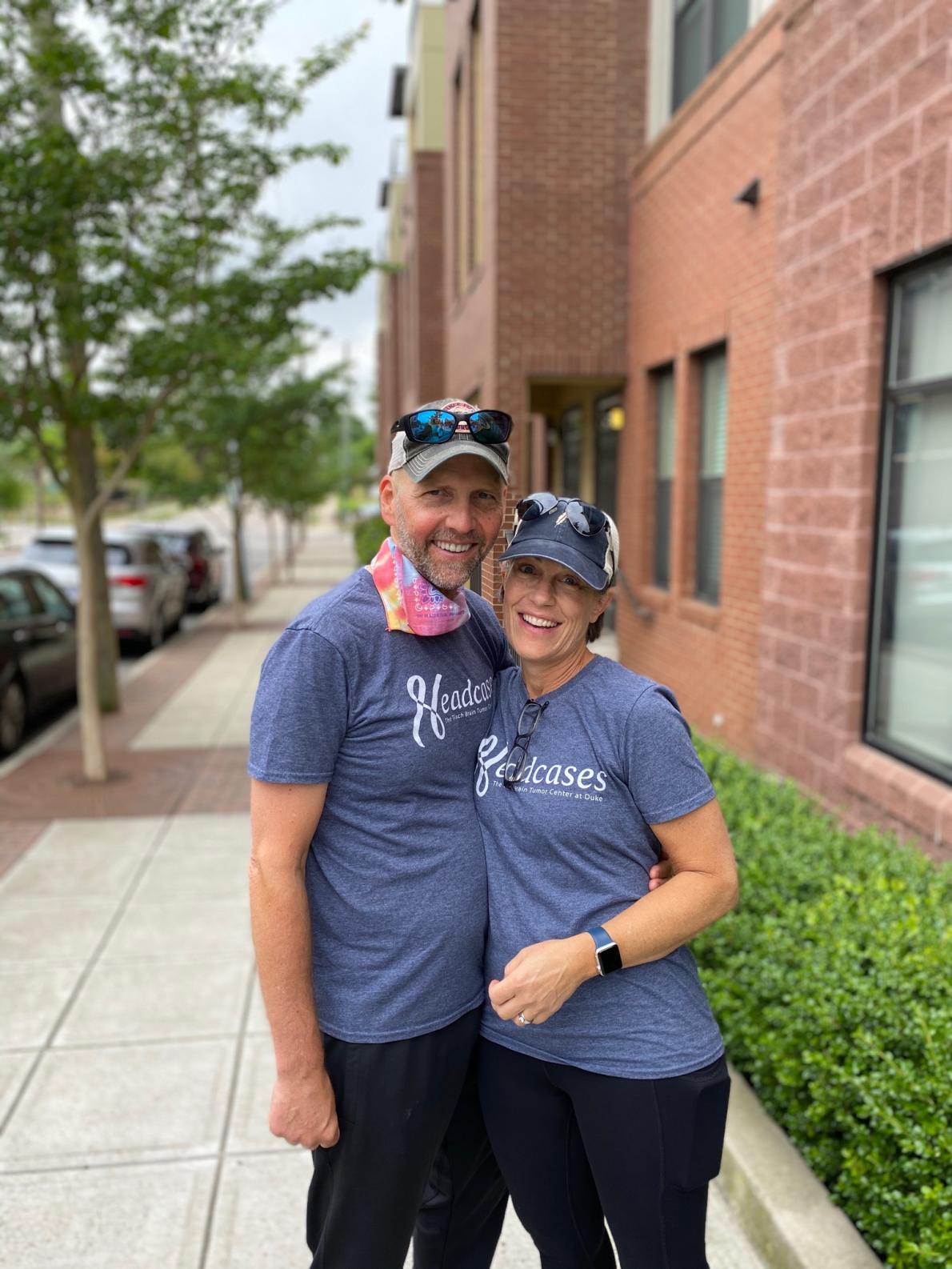
Twenty-five years ago, Brian Simmons was living in North Carolina with his wife and their three young sons, all in elementary school at the time. He worked in sales management and traveled frequently for work. Life was busy and routine.
One afternoon, while driving to meet a customer in Charlotte, Brian suddenly realized he could not move his body. He could still move his fingers and toes, but he was unable to speak or control the rest of his body. The episode lasted about thirty seconds and then passed. He was able to drive home, but the experience was concerning enough that he called his doctor, who advised him to monitor his symptoms.
Two weeks later, the same type of episode of not being able to move occurred while he was standing and talking with one of his sons. At that point, his primary care physician recommended he go to the emergency room for an MRI. Initial impressions suggested a stroke, but further review of the imaging identified a brain tumor.>
A biopsy confirmed an anaplastic oligodendroglioma, a grade three brain tumor located on the motor strip, the area of the brain that controls movement. Because of the tumor’s location, there was uncertainty about whether surgery could be performed safely. Brian and his family had recently moved to the area, but through a connection, they were referred to neurosurgeon Alan Friedman, MD, at Duke. After reviewing the imaging, Dr. Friedman recommended surgery and explained that an awake craniotomy would allow the surgical team to monitor movement and speech during the procedure.
Brian underwent surgery at Duke in July 2001. In September, he began radiation therapy and completed thirty rounds of treatment, followed by an oral chemotherapy regimen. He also began medication to manage seizures and continued with regular follow up MRIs over the years. During this time, he stepped away from working full time and focused on his health and his family. His condition remained stable.
Approximately eight years ago, Brian began experiencing focal seizures affecting his right side, particularly his leg. His Duke neuro-oncologist, Annick Desjardins, MD, referred him to an epilepsy specialist to help manage these symptoms.
Over the years, Brian and his family have continued their care at Duke. “Duke has really become family for us,” he said. “We do not think twice about the plan of care they recommend. There is always a level of awareness around how things are going and how they affect our family. Dr. Desjardins has always been very attentive. We never feel rushed, and we have never felt like a number. The team advocates for us.”
Since 2002, Brian and his family have participated in the Angels Among Us 5K and Walk for Hope each year. Their team, called Headcases, returns annually as part of a longstanding family tradition. In addition, Brian and his wife, who now own a real estate company, created a fundraising initiative called Parking for Patients, which helps cover parking costs for patients traveling to Duke for care.
“Twenty-five years later, I am still doing the 5K,” Brian said. “Seeing the number of survivors who participate each year is powerful. It is something that is important to our family, and it has been meaningful to watch the event grow over time.”
Today, Brian is feeling well and is no longer taking medication, though he continues to be monitored. He remains grateful for his care and for the opportunity to continue supporting others.
“We are thankful for the care we have received and for the chance to share this experience with others,” he said.